
The industrial market is on the verge of undergoing a fundamental change in the way consumers learn to find suppliers, manufacturers, and technical solutions.
Traditional methods of SEO have always dominated the digital presence, directing high-purposed traffic to web pages and achieving a conversion. However, the emergence of AI-enabled search engines and similar generation-based sites means that companies have a new challenge.
Now, AI systems can answer queries directly and cite sources without users ever clicking on a webpage. In fact, about 30% of keyword search results now trigger AI Overviews, showing how AI‑generated summaries are increasingly shaping what users see before traditional links appear.
This development has disturbed the traditional playbook of SEO and left the industrial marketer wondering whether their investments in rankings are still valuable.
Fortunately, the solution lies in understanding the dual forces shaping online visibility. A well-designed strategy can be aligned to have a maximized impact by relating them together using structured data, topical authority, and link-building.
The following blog will discuss the concept of AI Citations vs SEO Rankings, differences, synergies, and how industrial brands will take over visibility by 2026.
What Are AI Citations and Why They Matter for Your Brand?
The AI citations refer to your brand, a web page, or even content, which is present in the responses generated by the AI. These citations belong to the search ecosystem, which are usually displayed to the searcher in preview or even in place of conventional search results. Therefore, they are regarded as one of the main aspects of online presence.
AI citations typically appear as direct references inside generative answers, such as “According to [Brand X],” and are frequently included in AI Overviews that summarize complex or technical queries. These citations are usually sourced from high-quality, authoritative content that AI systems trust, making credibility and content quality essential for being referenced.
In comparison to the common search engine, the AI systems are evaluated on a different framework. They focus on factual correctness, well-organized data, and the use of the same entity to make sense and context.
Reliability is another significant factor, and sources with a long history and high authority are significantly more likely to be mentioned than thin or unverified ones.
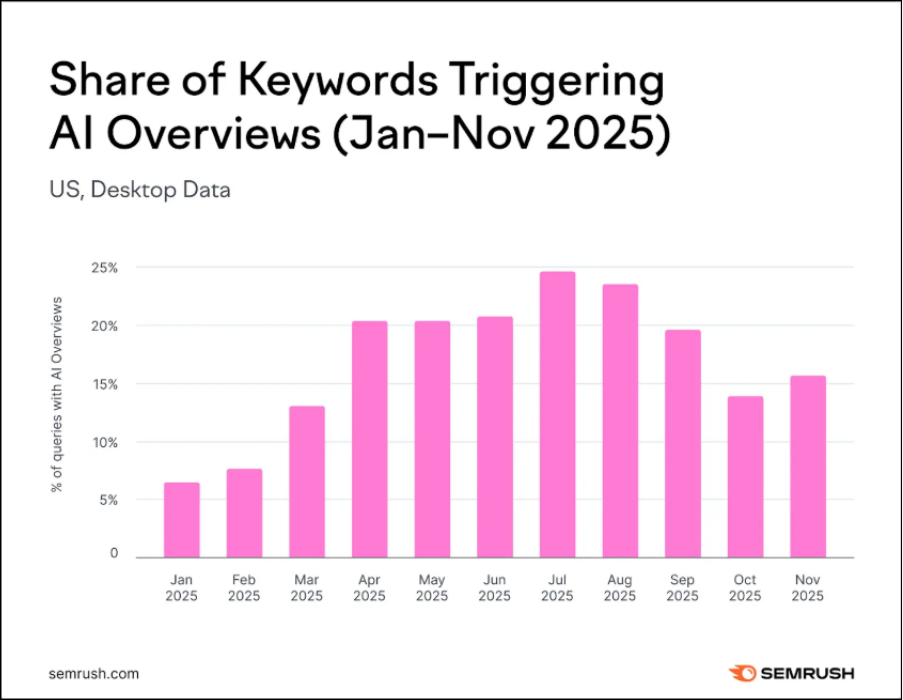
According to a SEMrush study, AI Overviews are triggered for about 15.7% of search queries, showing that AI-generated summaries are appearing on a growing share of SERPs. Although direct clicks may decrease, references still increase brand awareness and credibility immensely. AI citations act as authority signals, influencing both machine understanding and buyer trust in industrial decision-making.
SEO Rankings and Their Role in Driving Organic Visibility
SEO ranking does indicate the position of your content on Google. They assist industrial buyers in locating the correct solutions fast and redirect high-intent visitors directly to your site. Even in a progressive search space, which depends on AI, good rankings remain a source of visibility and power.
In 2026, core SEO ranking drivers still revolve around content quality, authority, and technical performance. Search engines are inclined towards content that demonstrates relevance, depth, and well-structured pages consistently outperform surface-level material. Hence, the authority of the backlink sources, and some technical indicators, including page speed, structured data, and mobile optimization, have a direct impact on rankings. The user engagement measures that include time on page and low bounces also reflect the content value and utility.
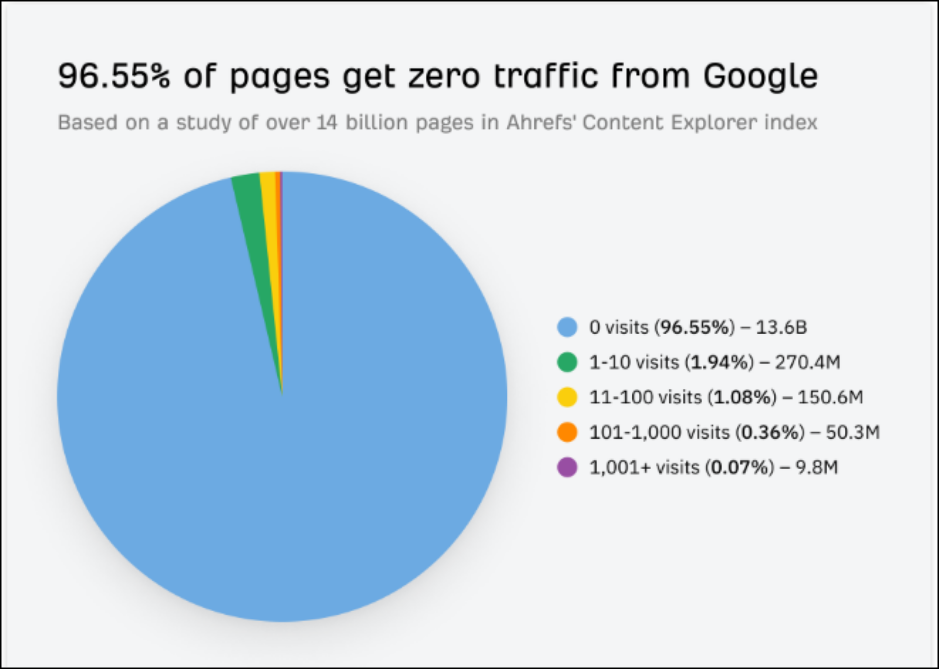
Even when competition increases, rankings are still a means to build quantifiable business value. Ahrefs states that 96.55 percent of all existing web pages obtain no organic search traffic whatsoever provided by Google, and that 1.94 percent of the web pages just get 1-10 monthly views. This underscores the level of difficulty in gaining visibility and the strength of superior rankings when they are attained. Therefore, top-ranking pages will also come in handy with brand awareness, traffic, and conversion, and serve as a credible source of data used by AI systems.
SEO is also necessary since it attracts users with specific intent, facilitates early-stage education during the shopping experience, and provides credible information that can be subsequently referred to and cited by the AI systems. Though AI is transforming the information surfacing experience, the search engine ranking remains the surest way to attain sustainable traffic, long-term authority, and predictable business growth.
Key Differences Between AI Citations and SEO
Understanding the structural differences of AI citations vs SEO rankings is essential for industrial marketers navigating modern search environments. Although they both affect visibility, they differ in how they work and the purpose they serve at various stages of the buyer’s journey. AI citations concentrate on direct conveying of information, and SEO rankings are concentrated on directing the user to their own online resources.
The two are further divided by traffic flow.
AI citations often lead to a zero-click experience where users do not follow through and browse the site hosting the information. The SEO ranking generates quantifiable traffic where direct interaction, which captures leads and converts, is feasible. In the case of industrial brands, this difference will be important since traffic is one of the key indicators of business purposes.
Signals of authority are also different in the two systems.
The chosen criteria of AI platforms depend on factual accuracy, context, structured data, and the freshness of content in determining what to cite. The classical SEO is based more on relevance, profile of backlinks, and metrics of user involvement.
Psychologically, a number one ranking may lose clicks to the top of the responses dominated by AI-generated answers. However, AI citations can elevate brand authority and trust before a user reaches a website.
Ultimately, AI citations and SEO rankings are not substitutes. They are mutually reinforcing since they affect various phases of discovery and decision-making across the industrial buyer journey.
Optimizing Content for Both
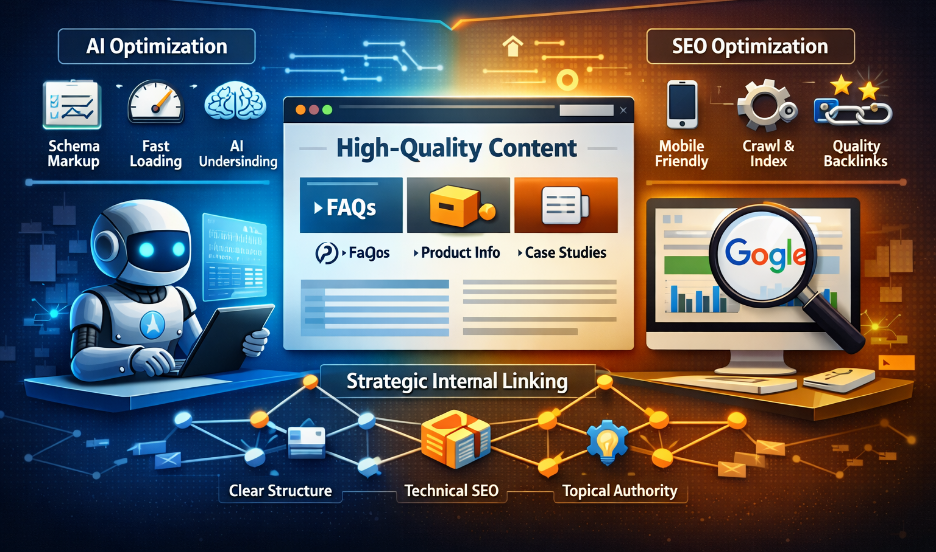
To remain competitive in the year 2026, industrial brands must have content that ranks well not only with AI systems but also with traditional search engines. This dual approach makes the content of the site authoritative, findable, and user-friendly.
Product, FAQs, and process schema markups not only enhance better indexing but also simplify the process through which AI can find and process necessary data.
Technical optimization is critical. Fast-loading, mobile-friendly pages with structured data ensure content is easily crawled and indexed by search engines while improving AI comprehension. Properly formatted content also enhances the user experience, reducing bounce rates and increasing engagement.
Finally, all this is connected through strategic interlinking. There are logical internal connections between product information, specifications, guides, and case studies, which are both navigational aids to AI and users. Such a blend of clarity, topical authority, semantic relevance, and technical SEO will guarantee the maximum visibility via all the digital touchpoints.
Boosting Authority with Link

Backlinks and domain authority continue to form the basis of industrial brand visibility even in the AI-first environment. The idea of backlinks is still considered a ranking factor in search engines, and high-authority websites have a better chance of being included in AI-generated content. Powerful backlinks contribute to credibility and allow companies in industries to sustain credibility on the internet.
Backlinks are also effective in AI. AI systems mention high-authority sites more often, so the combined link-building will directly affect the SEO ranking and AI mentions. Hence, powerful backlinks serve as an interface between the old traffic and the new AI presence.
Specialized companies, such as AI Citations vs SEO Rankings, offer specific link-building capabilities to companies that need recommendations. These services combine both authoritative content, which is properly organized and effective in link-building, to optimize visibility on both traditional and AI search engines to create a two-pronged discoverability effect.
Measuring True Impact
With changes in the industrial search, marketers must reconsider success. Traditional metrics of SEO do not require the same picture anymore, as AI citations can have much more influence on brand presence and perception by buyers. Although SEO information will still be necessary, industrial marketers now need to gauge AI-induced engagement to obtain a full picture of performance.
At the same time, AI-specific metrics have become critical. Measuring AI citation rate, references in generative responses, and zero-click traffic. Referral traffic through AI-generated sources provides brands with insights into their impact on the AI search environment. These measures indicate the frequency of users viewing your brand, despite them not having to access your site directly.
Finally, the brands are recommended to monitor the key tracking areas, such as SERP features, AI overview references to queries of interest, and platform mentions, e.g., in ChatGPT or Gemini. Awareness of brand mentions gives you the disparities between presence and conversions. Therefore, the strategic framework of AI Citations vs SEO Rankings can help pull the industrial brands to put these measurements across the channels into balance to have a more global view of the success in digital.
Aligning AI Citations with SEO for Sustainable Digital Growth
AI Citations Vs SEO Rankings is not about choosing one over the other in 2026, but rather a matter of unifying the two.
Early-stage research is supported by AI citations that create brand trust and authority prior to a user accessing a site. They also assist industrial firms to seem as trustworthy sources of the different answers generated by AI and affect the way the buyer views the selection process.
Meanwhile, search engine rankings remain necessary in the generation of verifiable traffic, interest, and conversion. Arranging authoritative and structured content to align with both technical SEO and strategic link-building, the industrial brands will be able to defeat both AI visibility and traditional search.
Thus, with this dual strategy, businesses not only gain greater positions but also gain long-term authority, awareness, and sustainable development in the changing digital environment.

About the author: Vibhav Gaur, Business Head
Vibhav Gaur leads strategic operations and business growth at the organization. With a strong background in digital transformation and customer-focused solutions, he has helped numerous clients streamline their web presence and scale efficiently. His leadership ensures seamless execution across teams, with a commitment to delivering results and fostering innovation in every project.


