
You have invested time, energy, and resources in creating your marketing funnel, but something feels off. The campaigns are polished, the landing pages are streamlined, and the content is good on paper. Nevertheless, the conversion rate is low, and your leads are not converting as quickly as you’d like.
It is because the funnel you were used to is no longer how it was. AI is silently transforming how the audience thinks, learns and chooses. Users who were previously using the linear path of awareness-conversion now interact with content through chatbots, AI-based search, and customized recommendations before it lands in their inboxes.
AI is not just another trend. It is reshaping the actual definition of marketing itself. Harvard Division of Continuing Education stated that AI is fast-changing the way that marketers comprehend audiences and create individualized experiences across channels.
This means that when a potential customer is searching for a solution to a problem, it is often an algorithm-powered by AI-that determines what to show them first, rather than your manual targeting.
Therefore, you now need an adaptive SEO and AI integration strategy that enhances visibility, builds trust signals, and engages higher-intent audiences as they navigate smart, automated funnels.
Interested to know how that can be achieved in your business?
Let’s dive in.
Why the AI-Driven Funnel Demands a New Approach
The conventional funnel used to be easy. You created awareness on the highest level, developed leads in the middle, and sealed deals on the bottom. However, AI has altered that order completely. Every click your visitor makes, whether it is scrolling a page, reading a headline, hovering a button, etc., is processed into a smart system that guesses what they want next.
Machine learning will track the trends and will automatically make adjustments based on your funnel engagement cues. It has now optimized content placement, messaging, and timing in real time depending on user behavior. This is where AI SEO services prove to be useful, as these services are more in line with the way algorithms interpret optimization efforts in regard to intent and behavior.
According to the recent data, the majority of marketers using AI report faster, data-driven decision-making and significant gains in campaign performance. That insight explains why your old funnel no longer performs as it once did. The buyer’s journey has evolved into a dynamic, continuous learning process.
For SEO, it means your visibility is no longer dependent on keywords or backlinks. It is based on the clarity of your content, communicating meaning and context to the intelligent systems that enable search, recommendations, and personalization.
Why Traditional Funnels Are Failing
Old funnels depend on order. You introduce your brand, create interest, nurture your audience, and finally ask for action. But that sequence no longer applies to how customers move.
Today, a prospect might discover your business through an AI-generated search overview, confirm your credibility in a chatbot conversation, and then complete a purchase after being retargeted by a personalized recommendation. Every stage overlaps and accelerates.
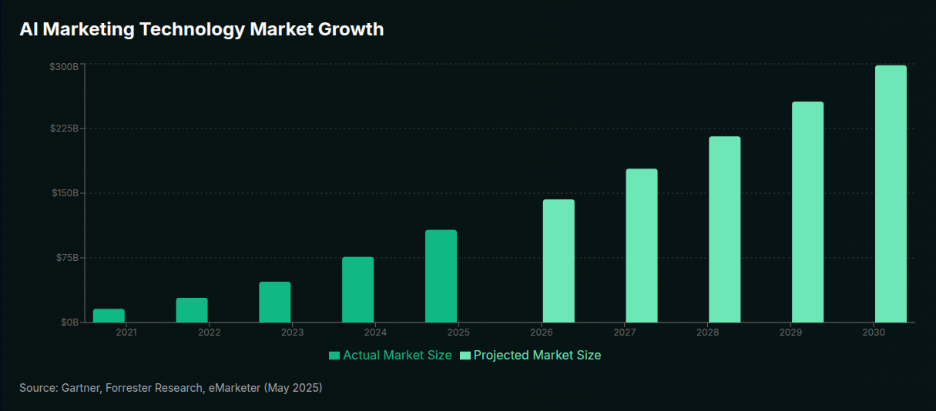
Aisofto’s 2025 marketing performance study revealed that companies integrating AI into their funnels increased revenue by 41% and reduced customer acquisition costs by 32%. These improvements happen because AI reacts faster than any manual campaign.
If your funnel is based on scheduled nurture messages or uses the same audience segmentation, it cannot compete. You must have a framework that adapts automatically, one in which SEO content is linked to purpose as fuel for AI-based personalization.
How AI Is Transforming SEO Across the Funnel
AI is not replacing SEO. It is redefining it. Words are no longer measured in search engines. They measure the success of your content in relation to its purpose and the retention duration of the user.
At the awareness phase, AI can determine the level of your content and its professionalism. During the consideration stage, it is concerned with accuracy, credibility, and clarity. It examines engagement indicators, such as scroll depth, interactions, and repeat visits, in order to comprehend trust at conversion.
When your search engine optimization is in line with these behavioral patterns, you will gain popularity. It does not simply seek to rank high, but also to create pages that are useful according to the algorithms.
Establish Trust And Authority In An Automated World
As AI allows anyone to generate content instantly, credibility has become more valuable than ever. Search engines, now powered by intelligent models, prioritize Experience, Expertise, Authoritativeness, and Trustworthiness (E-E-A-T) to decide which results deserve visibility.
Your material should contain human wisdom and genuine authority. Readers and algorithms seek evidence that your brand understands the topic, stands behind its message, and can be trusted. This includes offering transparent authorship, showcasing credible work or case studies, and citing reliable sources whenever possible.
Delivery can be automated, not credibility. Once the authenticity of your SEO is established, AI systems will reward it with stronger ranking indicators and consistent visibility.
Adapt to AI Search and Zero-Click Behaviour
The search summaries generated by AI are altering user behavior when viewing search results. The use of AI Overviews on the search page achieves this by providing answers to many users without requiring them to click through to a website.
This may sound like a threat, but it is an opportunity. When you put your content in an orderly, well-defined, and precisely formatted way-that is, with schema markup, clear formatting, and confirmed insights—it can be displayed right within those summaries. That positions your brand in front of users just as they are about to make a decision.

Semrush.com
A study conducted by SEMrush of more than 10 million search queries showed that AI Overviews, in 2025, were in 13.14% of the search results, compared to 6.49% the previous year. This goes to show that the search engines are becoming more and more reliant on summarized and quality data.
The new focus of your SEO strategy would be on providing intelligible, exhaustive, and properly organized content that AI systems could read and analyze easily. Write concise, properly structured answers that an artificial intelligence system can compute in a short period of time. As soon as your content becomes an authoritative source of AI-generated summaries, your brand expertise remains on display even to those who do not click through to your site.
How to Align SEO with the Future of AI-Driven Funnels
Your funnel and SEO should be an integrated system to remain relevant. Begin by researching high-intent search terms that show what real issues your audience is trying to resolve. Create content clusters on those topics, and link them within themselves to demonstrate depth and consistency.
Be sure that you have structured information and natural conversational phrasing to optimize your site structure to be understood by machines. Then concentrate on measuring worthwhile engagement instead of raw traffic – dwell time, level of interaction, and relevance are now more important than clicks.
An academic study of the role of AI in marketing states that AI and NLP applications are currently transforming marketing functions throughout.
To implement it practically, start by using AI to assist with analysis and workflow suggestions-while you retain full human control over quality, tone, and strategic direction. It is your voice that counts, although the technology can drive you to opportunities.
How SEO and AI Work Together to Drive Growth
Proper SEO gives AI clean and structured information. AI, in its turn, enhances the process of SEO as it is able to analyze user behavior faster than manual reporting could ever do. This collaboration assists in building a loop of further enhancement.
A funnel is AI-friendly and will be able to transform your visibility automatically. The more you engage, the more your content is shoved over by the system. This is because once the subjects become obsolete, the focus is switched to newer research. Each personalization makes your online presence better, and no extra human resources are required.
It is this synergy that provides the modern marketer with an advantage. Once your SEO plan communicates effectively with algorithms driven by AI, your funnel starts learning by itself. That is the way sustainable growth is constructed.
Lead with Intelligence, Not Just Optimization
The use of AI has not eliminated the need to market; it has raised the benchmarks of success. Funnels are no longer anchored on predetermined campaigns; funnels are anchored on ongoing learning. The rate of adaptation is the difference between gradual development and constant presence.
The impact of AI on the way customers learn about and trust your brand still remains. Nevertheless, automation cannot substitute the plausibility of real expertise, even though it is predictive and personalized.
Those marketers who succeed in this new environment will be those who combine strategic insight with real storytelling. Data-based insights may be used to drive decision-making, yet it is their creativity, compassion, and power that transform such insights into something engaging. With the advancement of algorithms, the ability of the human mind to interpret context, emotion, and nuance becomes even more essential.
Creating an AI-prepared funnel involves more than just acquiring new tools; it requires developing a culture of constant experimentation. Review, scrutinize, and polish your strategy regularly.
Empower your AI systems to learn from your users, while you learn from the data that such systems are creating. Such a partnership between human marketers and machine intelligence forms an agile ecosystem that becomes more powerful with each interaction.

About the author: Vibhav Gaur, Business Head
Vibhav Gaur leads strategic operations and business growth at the organization. With a strong background in digital transformation and customer-focused solutions, he has helped numerous clients streamline their web presence and scale efficiently. His leadership ensures seamless execution across teams, with a commitment to delivering results and fostering innovation in every project.


