
Are your ready-to-buy customers landing with you or with your competition?
Every day, countless people search for “best deals,” “discounts,” or “buy now” options, eager to make a purchase decision. Yet, despite this potential, many businesses overlook lower-funnel keywords, focusing instead on broad terms that may drive traffic but don’t lead to conversions.
Companies that prioritize a well-defined, sales-aligned funnel see a 36% higher customer retention rate—a compelling reason to align your funnel to capture these ready-to-buy customers.
This blueprint will shift your approach.
From building a targeted keyword list to optimizing your ad copy and content, we’ll guide you in creating a lower-funnel keyword strategy that captures high-intent users.
The result? Higher ROI, improved retention, and a strategy that keeps your brand top of mind.
Ready to capture the conversions that count?
Let’s get started.
Turning Searches into Sales: The Role of Lower Funnel Keywords
 semrush.com/blog
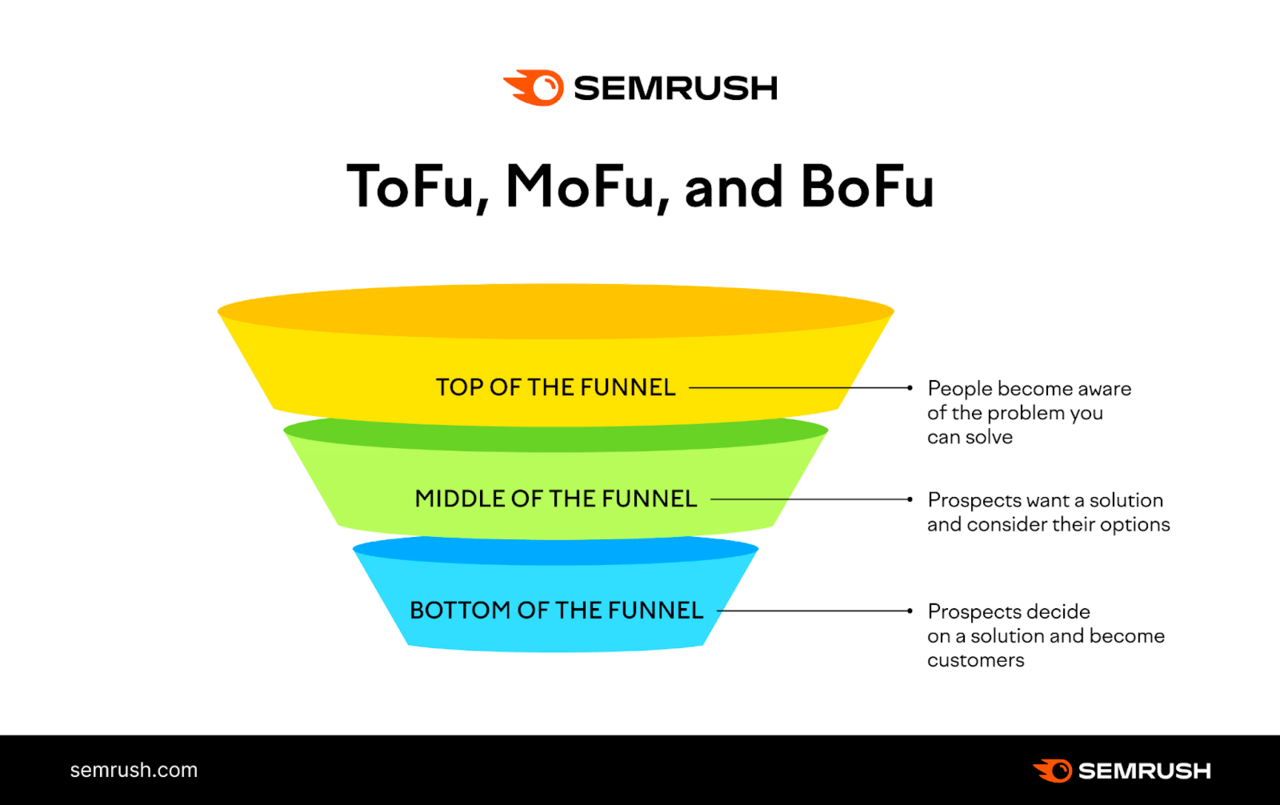
Lower-funnel keywords are the treasure trove of search terms as these phrases attract users willing to purchase desired products.
While the top-of-funnel keywords are broad and capture a wide array of users interested in what the business offers, the lower-funnel keywords do not take the intermediary steps and cut straight to the chase to target very specific aspects such as product names, the services offered, or use phrases such as “buy now” or “best price.”
 storychief.io/blog
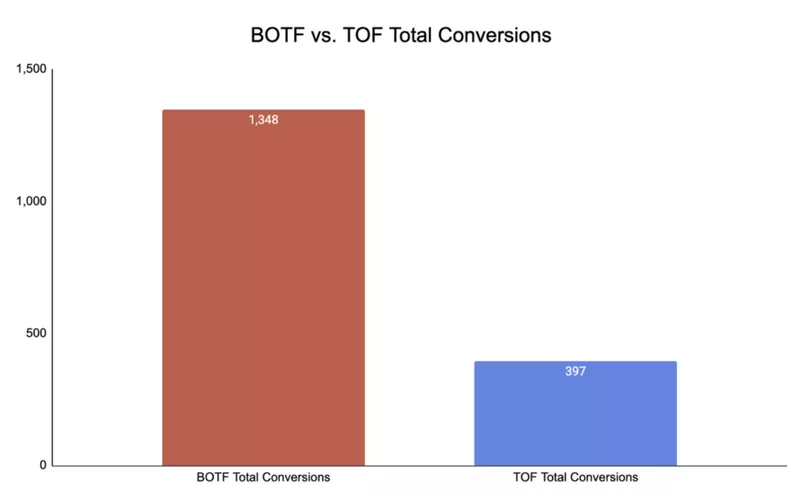
The payoff is significant: While the pages that target these bottoms of the funnel keywords rank, they have conversion rates ranging from 1% to 5%, in contrast to the 0.01% to 0.5% conversion rates of the pages targeting the top of the funnel information keywords.
This means that it is not just a mere percentage increase; it is a significant increase in the conversion rates that matter.
Types of Lower Funnel Keywords
Lower-funnel keywords generally fall into categories that suggest immediate action or high-intent research. Common types include:
- Purchase-driven Keywords: “buy now,” “get discount,” “sale price,” “order [product] online.”
- Comparison Terms: “product A vs. product B,” “best [product/service] for [specific need]”
- Location-based Searches: “[product] near me,” “[service] in [location]”
Fuel Your Sales with the Perfect Lower Funnel Keyword List
Lower-funnel keyword creation is perfect for sale; it’s essential to build a set that is ideal for the process. Such keywords will add traffic or visitors and also give consumers.
Are you ready to bring interested prospects to your company to power up a purchase?
Now, let’s amplify your sales by developing a keyword list.
Conducting Keyword Research
Start by zeroing in on keywords that scream, “I’m ready to buy.” These are action-driven, high-intent phrases like “buy [product] now,” “best price for [product],” or “compare [service].”
Don’t stop at broad terms—dive into long-tail keywords that are ultra-specific and face less competition.
ahrefs.com/blog
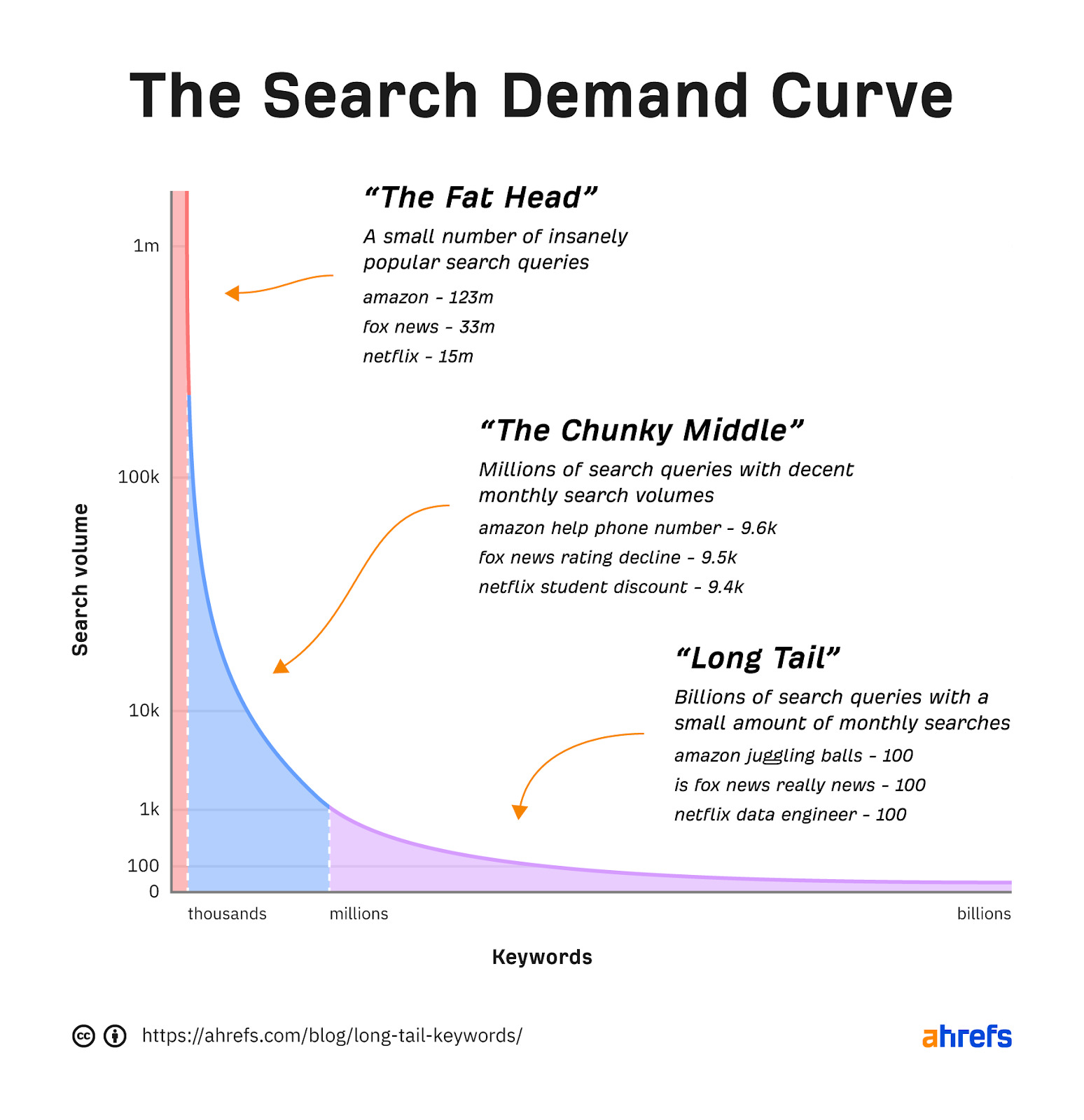
Long-tail keywords got their name from their position on the “search demand” curve.
When all search queries performed on Google in a given month are plotted and ordered by search volume, the above graph forms a curve that sharply drops off, creating the “long tail” at the end, where search volume is lower but more specific.
Tools and Techniques: Essential Tools for Researching High-Intent Keywords
To refine your lower-funnel keyword list, leverage these top tools and techniques:
- Google Keyword Planner: This can be used as the first step in searching for the keywords linked closely with your business. Target long tail keywords that you would want to rank for to ensure you focus your efforts on phrases that not only have relatively low competition but also those that indicate a given user is ready to purchase.
- SEMrush: It empowers you to get a better look at competitors and learn all about the lower funnel keywords your rivals employ. It is also practical to filter out high-intent keywords according to the behavioral characteristics of the users and their search.
- Ahrefs: Ahrefs is suitable for finding long-tail, high-converting keywords. It also assists in finding out some of the low-competition keywords that you can target easily, especially when they have an aspect of purchasing intent.
Optimizing Content for Lower Funnel Keywords
Turning high-intent clicks into actual sales is the sweet spot for any business—and it all starts with optimizing your content for lower-funnel keywords. Let’s dive into the winning tactics that will turn those clicks into conversions.
Types of Content that Seal the Deal
When customers are at the final stages of the buying journey, your content has to work harder to turn consideration into commitment. Here are some creative ways to meet their needs and help them hit “Buy Now.”
Show-Stopping Product Pages
This is where it all starts! Your product page should do more than just list features—it should paint a picture.
Integrate lower-funnel keywords like “buy [product] today” or “get [product] at the best price.” Bring the product to life with vivid descriptions, high-quality images, and a clear rundown of benefits. You’re not just selling a product; you’re selling an experience.
Customer Love Reviews
Nothing speaks louder than the voice of other customers. Showcase reviews that capture lower-funnel keywords like “best [service] reviews” and “buy [product] feedback.”
For instance, JustCall, which is a cloud phone system, has strategically placed different types of social proof on the home page, including G2 badges and app ratings.
 semrush.com/blog
Decision-Maker Comparison Guides
Guide consumers in making a buying decision by providing them with a comparison of the products. Including phrases such as “compare [product] vs [product],” you will target users who are already researching their options.
Expand on the benefits that your offerings offer and explain how they are competitively priced with other products on the market while highlighting their main selling points. It’s often the little push that people need to make their decisions, and having a well-written guide can give you the edge here.
Webflow has made several pages that involve a comparison of Webflow to other platforms. For example, here’s one of them:

semrush.com/blog
Crafting CTAs that Turn Intent into Action

blog.hubspot.com
In the lower funnel, every CTA is an opportunity to lead prospective consumers in making a purchase decision. Get it right by aligning CTA to their precise mindset—comparison, consideration, or decision. Here’s how to make them stand out:
- “Buy Now and Save 20%”: Tapping into urgency with a clear discount encourages immediate action.
- “Compare Prices Now”: Great for users who are specifically seeking comparisons, as it gives them a quick and clear method to consider multiple options.
- “Get Started with a Free Trial”: For services, making a no-lose trial can persuade users to proceed to the next step.
Here’s an effective example:
 blog.hubspot.com
What is one of the key issues that customers may face when subscribing to a particular service?
They fear that it might be inconvenient to cancel the subscription if they are not satisfied with the product. This specific concern is addressed fearlessly by Netflix with the “Cancel anytime” reminder statement, which is positioned right above the “Join Free for a Month” CTA.
Suffice it to say that this simple assurance has most probably increased signups by dissipating doubt. And let’s not forget an effective use of color either: this bright red of CTAs just corresponds with Netflix’s logotype, making the whole experience smooth, assertive, and easy for users.
SEO Mastery for High-impact Lower-Funnel Pages
Want the right audience to see your lower-funnel pages?
Optimize with these tested and tried techniques to attract ready-to-buy visitors and start seeing more conversions.
Spotlight Keywords: Speak Your Customer’s Language
Include your lower funnel keywords in the headings, subheadings, and in the content of the page. One should aim for a smooth flow that helps readers follow it with ease – no cramming needed! Turn every word into a calling that will create an impulse to buy.
Magnetic Meta Tags: Make Every Click Count
Your meta titles and descriptions are the “first impression” within search results. Use them to entice, intrigue, and directly address buyer intent. Use keywords, but briefly. Each word should spark interest.
Here’s how an effective meta tag looks like:
 ahrefs.com/blog
Here’s an example of a meta description:
 ahrefs.com/blog
Data That Delivers: Stand Out with Rich Snippets
Allow structured data to display rich snippet reviews, prices, and in-stock or availability. That little extra level of granularity really stands out in search results pages, and users also get what they need to feel confident enough to click through.
Here’s what a snippet looks like:
 semrush.com/blog
Polished URLs: Make It Short and Savvy
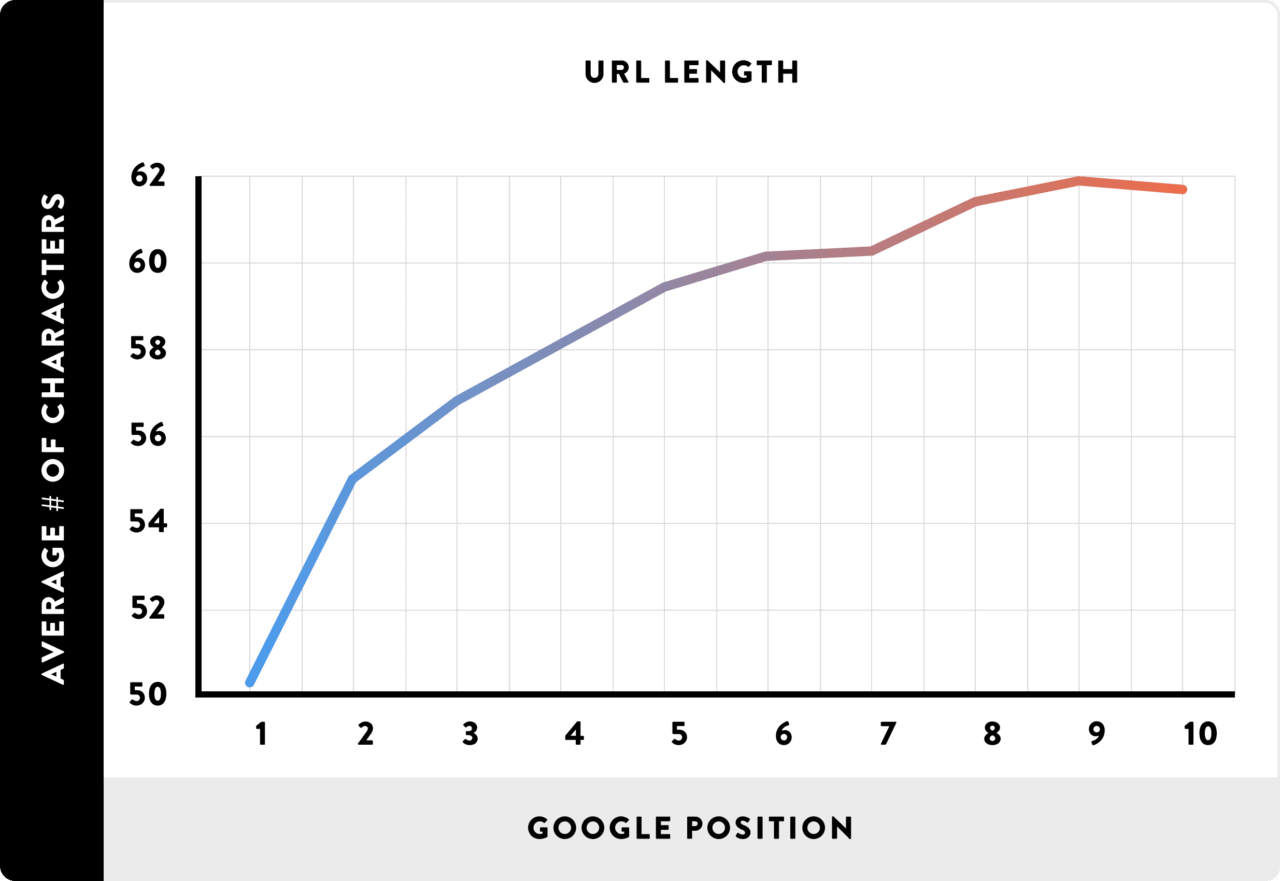
Make sure the URLs are short, packed with relevant keywords, and to the point. This should be clean and readable; the URL is a signal of credibility to the page and a keyword signal to the search engine right away.
 backlinko.com
The advantages of short URLs are that they will bring in better rankings for each page, and if you use them across your website, Google will have an easier time finding and crawling all your pages.
The Power of Lower Funnel Keywords in Paid Advertising
Nothing beats lower funnel keywords for paid advertising. Here’s how they can be utilized in order to drive ready-to-buy customers, leverage ad inventory, and provide a non-intrusive ad experience for possible buyers up to the point of purchase.
Laser-Focused Targeting: Turning Clicks into Conversions
Lower funnel keywords are more like “decision-mode” keywords. These are the phrases your potential buyers type in when they are about to make a decision – like ‘buy [product] today’ or ‘compare [service] options.’
Smart Bidding Strategies: Prioritize the Keywords That Count
It is, therefore, advisable to bid a bit higher for high-searched keywords while gaining the top ad positions that are effective for conversions.
By applying techniques such as Target CPA – Cost Per Acquisition – or Target ROAS – Return on Ad Spend, you are better off putting your advertising budget into the clicks that count.
This can be viewed as “quantity predicated by quality,” an approach that has more focus on value-oriented keywords rather than quantity.
Seamless Ad Experiences: From Click to Cart in a Single Flow
What is the secret to a highly converting ad?
Smooth, irresistible copy that feels aligned with the buyer’s journey. Use ad copy that shows intent, such as “Grab [Product] Now” or “Limited Offer on [Service].”.
Send them to a landing page that picks up the conversation right where your ad left off, laying it out with an easy-to-follow layout, clear benefits, and a CTA that practically begs to be clicked.
And when your ad and landing page speak the same language, you’re not just selling-you’re guiding them at every step.
Here’s an example:

semrush.com/blog
Liquid Death perfectly shows how important it is to understand the audience and speak in a language that would easily resonate with them. However, this packaged water brand uses an aesthetic, pretty rebellious outlook and message as it tries to hook young people who are bored with traditional brands.
 semrush.com/blog
Its marketing strategy involves bold Facebook ad headlines such as “Proudly not for everyone” and peculiar Calls to Action such as “Sell your soul for a free case. Murder your thirst.”
This approach emphasizes that not everyone is your audience; in having better relations with a particular audience, it is okay if you are bold, even to the point of leaving out certain people.
Building a Lasting Impact with Lower Funnel Keywords
A good lower funnel keywords approach is not just the momentary call of the last push for direct sales in the funnel; it builds the base for sustainable market development and customer retention.
Thus, from a long-term perspective, the described approach contributes to a cumulative process that strengthens the competitive position and value of the brand.
It is now high time to employ even more precise and specific keywords and incorporate them into the core of your strategies. Try using some of them in your advertising and content – see how it works and alter your content to see what your audience likes most.
This means that small changes could result in massive improvements, especially when optimization is done on actual data and customer feedback. Embrace it now, and you will be ahead of the game of increased conversion and customer retention.

About the author: Vibhav Gaur, Business Head
Vibhav Gaur leads strategic operations and business growth at the organization. With a strong background in digital transformation and customer-focused solutions, he has helped numerous clients streamline their web presence and scale efficiently. His leadership ensures seamless execution across teams, with a commitment to delivering results and fostering innovation in every project.


